iGaming Market Trends
Explore the future of iGaming with key trends and innovations shaping the industry.
- Innovative Game Designs
- Mobile Integration
- AI Personalization
- Secure Transactions
Discover the substantial growth and key drivers shaping the gambling industry today.
The gambling industry is experiencing transformative growth in 2025, with the primary keyword "gambling review" essential for understanding the sector's current trajectory. The industry is undergoing significant structural changes driven by technological advancements, regulatory shifts, and evolving consumer preferences that are reshaping how operators compete and engage with players.
The global gambling market is experiencing robust expansion in 2025. The online gambling market alone is estimated to be valued at USD 105.5 billion in 2025 and is projected to reach USD 286.4 billion by 2035, registering a compound annual growth rate (CAGR) of 10.5% over the forecast period. From a broader perspective, the combined casinos and online gambling industry reached an estimated $287.8 billion in 2025, having grown at a CAGR of 7.4% over the past five years.
Different market analyses reveal varying projections depending on their scope and methodology. One comprehensive report indicates the global casinos and gambling market is forecast to increase by USD 165.3 billion at a CAGR of 11.6% between 2024 and 2029, while another projects the market to reach USD 185.17 billion by 2033 with a CAGR of 7.66%. These projections underscore the market's strong momentum, though growth rates vary based on regional dynamics and market segments analyzed.
Several factors are propelling the gambling industry's expansion in 2025:
Uncover the latest structural changes and business model evolutions in the gambling industry.
How technology and regulatory changes contribute to a competitive edge.
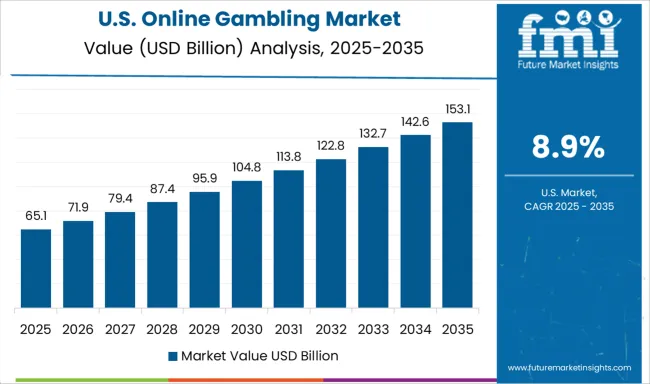
Sports betting represents one of the most dynamic segments within the gambling industry. The market segmentation across online gambling includes sports betting, casinos, bingo, poker, and other gaming formats. Sports betting is experiencing particularly strong growth, driven by increased mainstream acceptance and expanding legalization. The U.S. market, in particular, shows robust growth at 8.9% as more states legalize digital gambling and sportsbooks. This segment's expansion is fueled by younger consumers' preference for interactive, real-time betting experiences and the integration of sports betting with mobile platforms.
Mobile gaming has fundamentally shifted from being an alternative channel to becoming the primary means through which consumers engage with gambling platforms. This transformation extends beyond mere accessibility; it represents a complete reimagining of how gambling operators design platforms, manage customer relationships, and deliver content.
The implications of this shift are profound. Younger consumers particularly embrace mobile-first betting interfaces, with the Chinese online lottery market alone projected to expand by approximately $2.65 billion from 2025 to 2029, largely attributed to younger consumers using mobile devices as their preferred platforms. This generational preference creates expectations for seamless mobile experiences, quick loading times, and intuitive interfaces that align with broader digital entertainment consumption patterns.
Gambling operators are experiencing a fundamental shift from acquisition-focused strategies to customer retention and lifetime value optimization. With market maturation in developed regions and increasing customer acquisition costs, operators recognize that retaining existing players and maximizing their engagement generates superior returns compared to continuous acquisition cycles.
This evolution manifests in enhanced loyalty programs, personalized marketing communications, and customer service improvements. Casino design, loyalty programs, and social media marketing have become essential elements in attracting and retaining customers. Operators are also investing heavily in compliance training, customer service, and security protocols to ensure a safe and responsible gaming environment while building competitive differentiation through trust and reliability.
Compliance and responsible gaming have emerged as critical competitive differentiators in the gambling industry. As the sector matures and regulatory scrutiny increases, operators that demonstrate a strong commitment to responsible gaming practices and regulatory compliance gain competitive advantages. This includes implementing robust age verification systems, player protection tools, deposit limits, and self-exclusion options.
The emphasis on trust technologies reflects recognition that sustainable growth depends on maintaining industry legitimacy and public confidence. Operators employing sophisticated risk management and fraud prevention systems maintain financial stability while building consumer trust; a factor increasingly important to regulators and consumers alike.
The gambling review reveals an industry at an inflection point in 2025, characterized by robust market expansion, technological transformation, and structural evolution. The global online gambling market's trajectory toward USD 286.4 billion by 2035 reflects powerful underlying trends including mobile proliferation, regulatory expansion, and technological innovation reshaping competitive dynamics. However, this gambling review must also acknowledge substantial challenges including problem gambling concerns, regulatory complexity, and economic pressures that require industry attention.
Success in this evolved gambling landscape requires operators to simultaneously optimize growth while building sustainable, responsible business models that maintain consumer trust and regulatory compliance. The gambling industry's future depends not merely on market size expansion, but on demonstrating that growth aligns with consumer welfare and public health objectives. This gambling review underscores that competitive advantage increasingly flows to operators embracing transformation comprehensively—from mobile-first platform design to AI-enabled personalization to robust responsible gaming frameworks—rather than those pursuing growth through traditional acquisition-focused methodologies alone.
Proudly sponsored by leading industry experts.




Explore the future of iGaming with key trends and innovations shaping the industry.
Understand the explosive growth of sports betting and its impact on the market.
Artificial intelligence is transforming the gambling landscape, offering personalized experiences and improved safety.
Blockchain technology is ensuring transparency and fairness in online gambling operations.
Recent changes in gambling regulations are shaping market dynamics and opportunities.